
Concept Overview
For a given object traveling in a curved vertical path, free fall and initial velocity are independent of each other.
Lecturer Procedure for Demonstration(s)
| Steps to Follow | Expected Result | Explanation |
|---|---|---|
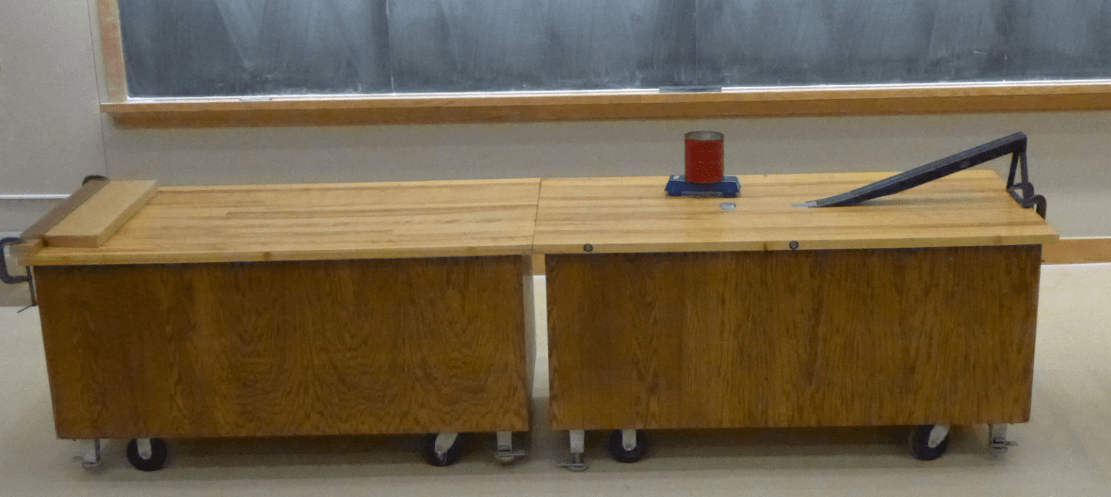
| Ball will launch vertically and return to the can. | This short demonstration shows the student that the mechanism provides no forward velocity to the ball. |
| Car will travel down the ramp, over the slug, and into the foam.
The ball will launch, travel in an ached path, and return to the can. | The path of the ball is the result of the vertical motion provided by the launching mechanism and the horizontal motion provided by the movement of the car. |
Variations on this Demonstration
- The car travels down the ramp and across an empty table.
- The car travels down the ramp and across an empty table. The ball travels though a hoop suspended above the path of the car.
- The car travels down the ramp and through a tunnel. The ball travels over the tunnel and returns to the car.
Historical References; Taken from original work of Percy H. Carr, 1970
“I suggest that at this point the students be given a chance to comment or to ask questions. Some perceiving student will often ask something like ‘what about friction?’, ‘doesn’t the cart slow down?’, or ‘why doesn’t the ball get ahead because we know the cart must be slowing down?’ If such a question is not asked, you can introduce the subject by saying that in the past you have had students who did ask, -- pick the phrasing you want. Then you can explain that yes, friction does play a part, --and an important part. Since air friction on the ball varies as the square of the speed in this speed range while the rolling friction on the cart is essentially constant, the effects of friction on the ball’s motion relative to the effects of friction on the cart will be greater at higher speed and less at lower speeds. (Here, the time interval is the same for each trial.) (why?)”
“Repeat the experiment for a very slow speed case and for a very high speed case compared to the speed first used (the “proper” speed), and the results are readily evident.
“Thus, we end up without having proved anything really, but the students have much clearer ideas on two counts, -- independence of motion along orthogonal directions and behavioral difference between fluid friction and solid rolling friction.
“There are at present (1969) two balls drilled to fit the vertical post. One is of wood pointed [sic] red, the other of cork painted silver. The denser wood ball is to be recommended, though either works and possesses its own ‘proper’ horizontal speed.”
Added in black pen to Professor Carr’s original work: “There are 6 drilled – 4 wood, 2 cork [sic] Also, there are several [scribble] balls not yet drilled but bought for this demo. Peters 8/89”
Demonstration Video
There is no audio with this video